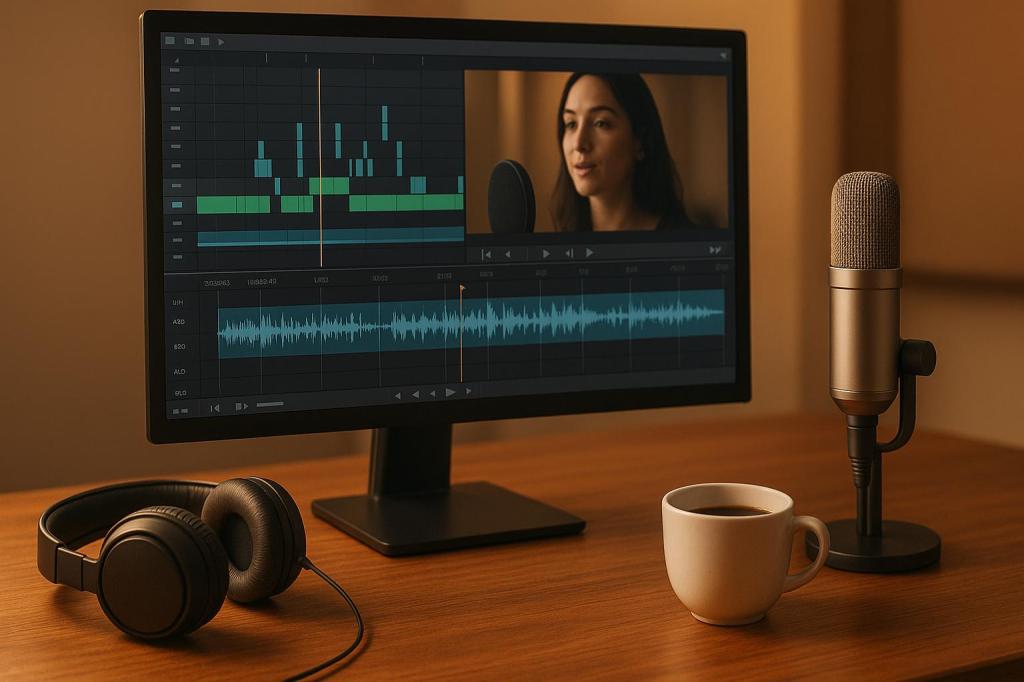
Perfectly syncing audio with video is crucial for professional dubbing. It ensures the dialogue matches lip movements, emotions, and timing, making the content feel natural and engaging. Poor synchronization can distract viewers, reduce emotional impact, and hurt the credibility of your content.
Key Takeaways:
- Why Sync Matters: Proper sync keeps viewers engaged and enhances storytelling. Poor sync breaks immersion and reduces trust.
- Challenges: Lip-sync errors, audio delays, and timing differences across languages are common issues.
-
Solutions:
- Manual Methods: Use clapperboards, waveform matching, and timecodes for precise alignment.
- AI Tools: AI-driven lip-sync tools like VisualDub save time and improve accuracy, handling multi-speaker scenes and live events.
- Workflow Tips: Maintain consistent technical specs (e.g., 48kHz audio, same frame rates) and adapt scripts to match language and visuals.
- Quality Control: Test for lip-sync accuracy, natural dialogue flow, and cultural relevance to ensure high standards.
By combining manual techniques with AI-powered tools, you can achieve professional-quality dubbing that resonates with global audiences.
AI-Powered Dubbing & Lip Syncing Tools For Video Localization
Core Tools and Methods for Sync
Achieving professional dubbing quality is all about mastering the balance between manual techniques and AI-powered tools. A seamless audio-video sync often relies on combining the precision of manual methods with the efficiency of advanced technology.
Manual Sync Methods
Manual synchronization forms the backbone of any dubbing process. It gives editors hands-on control, ensuring frame-perfect alignment and setting a strong foundation for automation.
- Clapperboard alignment: This classic tool provides a clear visual and audio marker, helping editors sync footage from multiple cameras or recording sessions. Even in today’s digital workflows, it eliminates guesswork and establishes a reliable starting point.
- Waveform matching: By visually analyzing audio waveforms, editors can identify sync points. This method is particularly effective for matching dialogue peaks to visual cues, especially when the speech has distinct rhythm patterns.
- Timecode-based synchronization: When recording devices are synced with the same timecode, editors can align footage with frame-level precision. This method is invaluable for multi-camera shoots or when combining footage from different sources.
Brandon Copple, Head of Content at Descript, explains, "when advanced editing software handles the heavy lifting, you’re free to spend more time perfecting creative storytelling elements rather than fighting with off-sync clips".
For longer productions, establishing multiple sync reference points throughout the timeline can help counteract potential drift. Once this manual groundwork is laid, AI tools can step in to refine the process further.
AI-Powered Sync Tools
AI tools have revolutionized synchronization by automating tasks that once required hours of manual work. These tools not only save time but also tackle complex scenarios with remarkable accuracy.
- Phoneme-level lip-sync: AI systems break speech into individual sounds (phonemes) and map them to corresponding mouth movements. This ensures natural synchronization, even in close-up shots.
Platforms like VisualDub by NeuralGarage showcase this advanced capability, delivering studio-quality lip-sync in over 35 languages. It excels in handling intricate scenarios, such as multi-speaker scenes, profile shots, or even partially obscured faces, while maintaining visual realism.
A real-world example highlights the impact of this technology: In 2025, Washington Square Films used AI to create localized ads from a live sporting event. The system matched dubbed audio to the original footage, eliminating the need for costly reshoots and significantly reducing production time.
AI-powered tools can synchronize projects in minutes, aligning speech segments with lip movements while preserving emotional nuances. However, not all tools are created equal. When choosing an AI sync solution, look for capabilities like support for multiple languages and accents, effective handling of multi-speaker scenarios, and the ability to maintain emotional depth.
Combining manual precision with AI enhancements creates a hybrid workflow that delivers both accuracy and efficiency. That said, human oversight remains essential – always perform a final visual and auditory check to ensure flawless synchronization.
These methods form part of a broader workflow designed to achieve top-tier dubbing results, which will be explored further in the upcoming sections.
Setting Up Your Dubbing Workflow
Managing a well-structured workflow is key to avoiding unnecessary delays. It ensures your assets are ready and your scripts are fine-tuned for the dubbing process.
Preparing Audio and Video Files
The quality of your dubbing project hinges on the source material. Keeping your technical specifications consistent across all files is crucial to avoid issues like sync drift or compatibility problems.
For smooth editing, make sure all devices operate with the same frame rates and codecs. Any mismatch can lead to sync issues, especially during longer recordings. Similarly, audio sample rates require attention. Stick with the industry standard of 48kHz for video production to prevent timing problems.
During recording, establish clear sync markers to simplify the editing process. The recording environment also plays a significant role. Use high-quality audio equipment and record in a quiet, controlled space to ensure clean sound. Test your microphone levels beforehand to maintain consistency throughout the session.
Digital Audio Workstations (DAWs) are essential tools for managing your workflow. Opt for a DAW that supports timecode markers and sync locks to keep everything aligned during the editing phase.
Once your technical setup is solid, the next step is refining your script to align with both the language and the visuals.
Script Adaptation for Different Languages
Adapting scripts for dubbing is more than just translating words – it’s about capturing the original tone and syncing it seamlessly with the visuals. Timing and rhythm often take priority over literal translations. The goal is to match the dubbed language with the original pacing and emotional intent.
Cultural nuances also play a big role. References, idioms, and expressions should be adjusted to make sense to the target audience while staying true to the characters’ personalities. Adjusting line lengths and rhythms is another critical step to ensure the dialogue aligns naturally with the visible mouth movements.
Character consistency is key to maintaining the audience’s connection to the story. Each character’s voice and personality should remain distinct and believable throughout the project. For example, Crunchyroll’s anime localization process is a great example of effective script adaptation. Their teams collaborate closely with voice actors to ensure the English dialogue fits the limited lip movements often seen in Japanese animation.
sbb-itb-818e448
Advanced Sync Techniques
When it comes to complex dubbing scenarios like multi-speaker scenes or live events, basic synchronization methods often fall short. That’s where advanced techniques step in, leveraging more precise tools and AI-driven solutions to handle these challenges effectively.
Syncing Multi-Speaker Scenes
Group scenes with overlapping dialogue can be a nightmare for traditional syncing methods. But AI tools now make it possible to isolate individual faces and assign audio clips to each speaker seamlessly.
The process involves separating each speaker’s audio track and aligning it with their facial movements. Editing software like Adobe Premiere Pro, Final Cut Pro X, and DaVinci Resolve can detect overlapping audio spikes across tracks and synchronize them automatically. This not only saves time but ensures accuracy.
Voice cloning adds another layer of precision, replicating the original vocal traits while ensuring the dubbed audio matches the speaker’s movements.
A great example of this in action is JFrog, whose CEO, Shlomi Ben Haim, shared how AI-powered dubbing improved their global engagement by 150%. He noted, “their international community feels more connected than ever, driving brand recognition and growth”.
Real-Time Lip-Sync Processing
For live events, streaming, or projects with tight deadlines, real-time synchronization is crucial. Advanced AI models now make it possible to produce high-quality audio and text translations on the fly, integrating smoothly into live streaming workflows.
This approach is particularly useful for news broadcasts, corporate events, and sports coverage, where timing and clarity are everything. Features like adjustable speaking rates, regional accent options, and ASR dictionaries allow for fine-tuning, ensuring content resonates with diverse audiences and accurately conveys key terms.
The benefits are clear. In 2025, one of Europe’s largest news broadcasters managed to release stories in 13 languages across websites, social media, and live broadcasts – all within 15 minutes of breaking news.
"Real Time Dubbing ensures your message is clear and accessible, driving engagement and revenue growth." – Dubme
The backbone of this real-time processing is cutting-edge technology like VisualDub’s generative AI. It delivers studio-quality lip-sync for video content in over 35 languages while maintaining perfect audio alignment. This ensures an immersive experience that keeps viewers engaged and connected to your message.
Quality Control for Dubbing Projects
After mastering advanced synchronization techniques, rigorous quality control steps in to ensure every dubbing project meets professional standards. Even the most sophisticated workflows can falter without thorough testing and evaluation.
Measuring Lip-Sync Accuracy
The foundation of quality dubbing lies in precise lip-sync measurements. Traditional metrics like Mouth Landmark Distance (LMD) and LSE-C establish benchmarks by tracking how closely dubbed audio matches the original video’s lip movements. Meanwhile, newer methods, such as those using AV-HuBERT features, provide a more detailed analysis.
Three key metrics – AVSu, AVSm, and AVSv – are often used to evaluate synchronization:
- AVSu (Unsupervised Audio-Visual Synchronization): Assesses the relationship between the provided audio and the generated video content.
- AVSm (Multimodal Audio-Visual Synchronization): Compares generated videos to ground truth footage, ensuring alignment with the original.
- AVSv (Visual-only Lip Synchronization): Focuses solely on lip movements, independent of audio considerations.
These tools prioritize accuracy and efficiency, enabling production teams to meet tight deadlines while maintaining high standards.
Performance testing highlights the differences between traditional and advanced AI-driven approaches. For example, multilingual advertising campaigns show that AI tools consistently deliver more accurate translations with realistic lip-syncing, while traditional methods often struggle with precise facial synchronization. Similarly, in animated productions, AI solutions excel in producing high-quality results across a variety of languages and character types.
However, multilingual dubbing projects bring additional challenges that require even more detailed testing.
Testing Multilingual Dubbing
Multilingual dubbing demands testing protocols that go beyond synchronization. Quality control in these projects focuses on ensuring accuracy, emotional impact, and relevance for all target audiences. This involves multiple revision cycles and input from linguistic experts, regional consultants, and test audiences.
Key testing elements include:
- Dialogue Naturalness: Ensuring the dubbed script flows naturally in the target language.
- Cultural Accuracy: Aligning content with local customs and expectations.
- Viewer Engagement: Monitoring audience feedback and comparing the dubbed content to local productions.
Additional attention to voice characteristics and subtitle integration ensures that tone, pacing, and delivery feel authentic to regional viewers.
Netflix’s research highlights the importance of high-quality dubbing, revealing that dubbed versions often outperform subtitled content in viewer engagement. Kelly Luegenbiehl, Netflix’s VP of International Originals for Europe, Turkey, and Africa, explained:
"People say they prefer the original, but our figures show they watch the dubbed version."
Quality control is the final safeguard in a process built on precise manual and AI-assisted synchronization tools. Advanced AI solutions play a critical role in maintaining consistent standards across diverse global markets.
Key Points for Professional Dubbing
Professional dubbing hinges on three main techniques: AI-driven lip-sync, voice cloning, and precise timing. These elements are the backbone of professional dubbing, enabling faster project completion and expanding content reach to broader audiences.
AI-powered dubbing has revolutionized the process, delivering results about five times faster than traditional methods. Automated workflows can process a single minute of video in just 5–10 minutes. This efficiency not only speeds up production but also cuts costs by reducing the need for extended studio time and voice actor sessions, while ensuring consistency across multiple languages.
The benefits extend beyond production efficiency – localized audio significantly enhances viewer engagement. Studies show that localized dubbing increases average view duration by 40–70% compared to subtitles alone. On the flip side, poorly aligned lip movements can reduce retention by 45% and impair comprehension by 30%. These figures highlight why achieving precise synchronization is critical for content success.
Advancements in AI tools continue to raise the bar for dubbing quality. For example, VisualDub uses generative AI to create realistic, language-agnostic lip-syncing. One standout case is NeuralGarage’s collaboration with Amazon India, where they used generative AI to transform ad campaigns, marking a global milestone in AI-driven content creation.
"The aim behind VisualDub has been to minimize visual dissonance in content and media. We are committed to continuous innovation, pushing the boundaries of generative AI and extending its reach into various industries", says Subhabrata Debnath, Co-founder and CTO at NeuralGarage.
For optimal results, look for AI dubbing tools that allow manual adjustments for pitch, style, and speed. Additionally, solutions offering extensive language and accent support are crucial when targeting global audiences. Combining AI automation with human oversight ensures a balance of efficiency, quality, and data security throughout the dubbing process.
The growing demand for automated dubbing services is reflected in market projections, which estimate the industry will reach $189.80 million by 2030. This growth underscores how AI-powered dubbing is reshaping the landscape, offering scalability, faster delivery, and improved accuracy compared to traditional methods.
FAQs
How can I adapt scripts for dubbing to maintain cultural relevance and emotional impact?
To create dubbing that truly resonates with audiences, it’s essential to move beyond simple word-for-word translation. The script should be adapted to reflect references, idioms, and humor that align with the target culture, all while preserving the original tone and intent. This approach helps the message feel natural and relatable to viewers.
Choosing the right voice talent is just as crucial. Voice actors need to convey the emotional nuances, timing, and rhythm of the original performance to ensure the dubbed version feels genuine and engaging. When you combine a well-adapted script with skilled voice acting, the result is a smooth and captivating experience for audiences across different languages.
What should I consider when selecting an AI-powered tool for professional lip-syncing?
When selecting an AI-powered tool for professional lip-syncing, focus on precision – the audio and visuals need to align perfectly to achieve natural, lifelike lip movements. This ensures your final product looks polished and believable.
Ease of use is another key factor. A tool with a straightforward, intuitive interface makes it simpler to tweak settings and maintain control over the process. Also, consider compatibility – the tool should work smoothly with your current video editing software and support the file formats you use regularly, helping you avoid unnecessary headaches during production.
Look for tools that offer customization features, like options to modify accents or adjust emotional expressions. These can significantly improve the quality of localized content. Lastly, don’t overlook processing speed and overall performance. A tool that can keep up with your production demands without lagging will save you time and keep your workflow running smoothly.
How does AI make syncing audio and video faster and more accurate than manual methods?
AI has transformed the way audio and video are synced, taking over tasks that used to demand hours of meticulous manual work. With advanced algorithms, it processes both audio and video in real-time, pinpointing exact synchronization points with extraordinary precision. This not only speeds up the process but also cuts down on the likelihood of human error.
Beyond just saving time, AI elevates the quality of dubbing by aligning vocal traits, emotional nuances, and timing with the original performance. It adjusts speech to suit the context of each scene, delivering a smooth and natural result that’s hard to replicate through manual effort. The outcome? A faster production process and a polished final product that meets industry standards.
Related posts
https://app.seobotai.com/banner/banner.js?id=6837ae0cd3b9661981875b9f
 VisualDub blog
Leave a comment